4D Health Science Physiotherapy Application
Covosys partnered with 4D Health Science to develop a HIPAA-compliant platform that empowers elderly patients to remember and perform physiotherapy exercises correctly at home, while enabling therapists to monitor 3x more patients through AI-powered motion tracking and automated progress reporting.

Bridging Physical Therapy and Remote Care
Physical therapy faces a persistent challenge that affects both patient outcomes and healthcare efficiency. Elderly patients, who make up a significant portion of physiotherapy clientele, often struggle to remember the specific exercises prescribed during their sessions. The precise form, repetition count, and movement patterns demonstrated in the clinic become unclear once patients return home, leading to incorrect exercise execution and compromised recovery outcomes.
This problem is compounded by the severe time constraints physiotherapists face in clinical settings. With appointment slots typically limited to 15-30 minutes and practitioners managing dozens of patients daily, therapists have minimal time to thoroughly teach exercises, verify patient understanding, and provide personalized feedback. The result is a healthcare bottleneck where quality of care suffers due to volume demands, and patients leave sessions without the confidence or knowledge to properly continue their treatment at home.
4D Health Science recognized that these interconnected challenges required a technological solution that could extend the therapist's reach beyond the clinic walls. They needed a platform that would serve as a virtual assistant for patients: one that could demonstrate exercises with precision, track patient movements in real-time, provide corrective feedback, and alert therapists to issues requiring intervention. This solution had to be intuitive enough for elderly users with limited technical skills while maintaining the clinical rigor and HIPAA compliance required for healthcare applications. The platform also needed to scale efficiently, allowing a single therapist to effectively monitor and guide multiple patients simultaneously without sacrificing quality of care.
A Comprehensive Telehealth Platform
Covosys designed and developed a sophisticated telehealth platform that combines cutting-edge computer vision technology with healthcare-grade security infrastructure. Our solution leverages WebGL-based 3D rendering and machine learning algorithms to provide real-time motion tracking that rivals in-person assessment accuracy.
The platform's architecture was built from the ground up with HIPAA compliance as a foundational requirement, not an afterthought. We implemented AWS GovCloud infrastructure to ensure the highest levels of data security and regulatory compliance. Every component (from the video streaming layer to the patient dashboard) was designed with encryption, access controls, and audit capabilities built in.
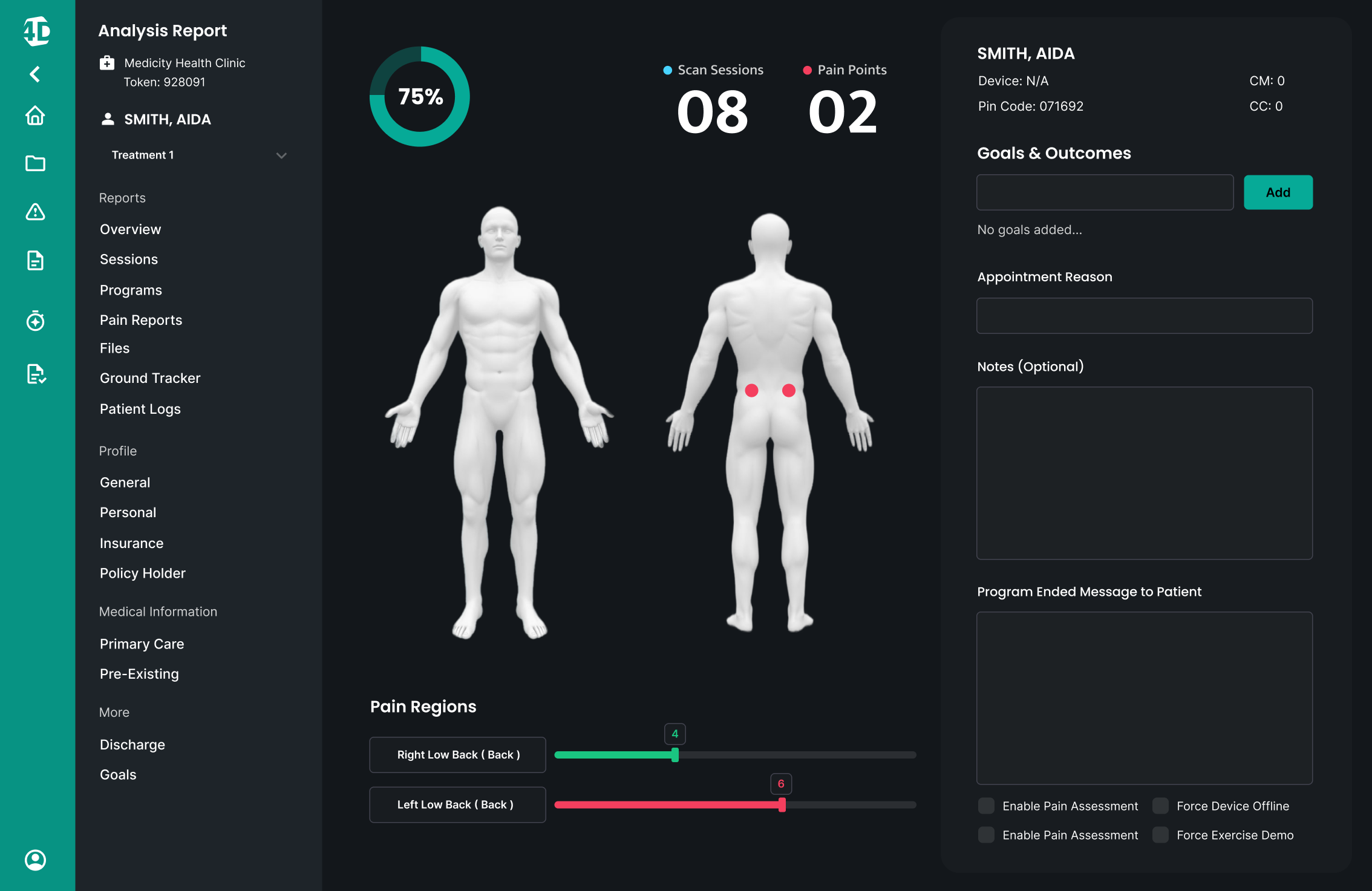
Our development team created an intuitive interface that abstracts away technical complexity, allowing both therapists and patients to focus on the therapy itself. The system uses advanced pose estimation algorithms to track patient movements through their device camera, comparing them against ideal movement patterns and providing instant visual and audio feedback. Therapists can monitor multiple data streams simultaneously: live video, 3D skeletal tracking, pain assessments, and exercise adherence metrics, all within a unified dashboard.
To address scalability and performance requirements, we implemented a microservices architecture with intelligent load balancing and edge caching. This ensures that even during peak usage, patients experience smooth, responsive sessions with minimal latency. The platform also includes comprehensive analytics and reporting tools, enabling therapists to track patient progress over time and adjust treatment plans based on objective data.
Core Features & Capabilities
The platform includes comprehensive security measures and healthcare-specific features designed for optimal patient care.

Implementation Phases
Discovery & Planning
Conducted extensive stakeholder interviews with physiotherapists, elderly patients, and clinic administrators to understand workflow patterns, pain points, and technical constraints. Developed detailed user personas and journey maps to guide UX design for accessibility.
Security & Compliance Foundation
Established HIPAA-compliant infrastructure on AWS GovCloud with end-to-end encryption, secure access controls, and comprehensive audit logging. Implemented role-based permissions and data isolation to protect sensitive patient health information.
Core Platform Development
Built the 3D motion tracking system using WebGL and machine learning models for pose estimation. Developed the patient exercise library with video demonstrations, the therapist dashboard for multi-patient monitoring, and real-time corrective feedback mechanisms.
User Testing & Iteration
Conducted usability testing with elderly patients to refine the interface for simplicity and accessibility. Implemented voice guidance, large touch targets, and simplified navigation based on user feedback. Iterated on the motion tracking algorithms to improve accuracy across different lighting conditions and camera qualities.
Clinical Validation & Launch
Performed rigorous security audits and HIPAA compliance validation. Conducted pilot programs with select physiotherapy clinics to validate clinical effectiveness and gather real-world performance data. Successfully deployed the platform with comprehensive training programs for therapists and patients.
Technical Implementation
Our technology stack was carefully selected to balance performance, security, and accessibility, ensuring a robust platform that serves both elderly patients and busy healthcare professionals.
Frontend
React with WebGL for 3D rendering
Built with React for component reusability and WebGL for hardware-accelerated 3D motion visualization, ensuring smooth performance even on older devices commonly used by elderly patients.
Motion Tracking
TensorFlow.js & MediaPipe
Implemented real-time pose estimation using TensorFlow.js and MediaPipe for accurate skeletal tracking, with custom ML models trained on physiotherapy-specific movements for higher accuracy.
Backend
Node.js with Express
Scalable microservices architecture using Node.js for handling concurrent video streams, real-time data processing, and secure API endpoints with rate limiting and authentication.
Data Management
HIPAA-compliant PostgreSQL
Encrypted database with automated backups, audit logging, and strict access controls. All PHI (Protected Health Information) stored with AES-256 encryption at rest.
Video Infrastructure
WebRTC & AWS Kinesis
Low-latency video streaming using WebRTC for real-time sessions, with AWS Kinesis for recording and playback, ensuring sub-300ms latency for motion correction feedback.
Cloud Infrastructure
AWS GovCloud deployment
Enterprise-grade security with AWS GovCloud, featuring VPC isolation, CloudWatch monitoring, automated scaling, and comprehensive disaster recovery protocols for 99.9% uptime.
The technical architecture was designed with a mobile-first approach, recognizing that most elderly patients would access the platform through tablets or smartphones rather than desktop computers. We optimized the motion tracking algorithms to run efficiently on devices with limited processing power, utilizing TensorFlow.js for client-side inference to minimize latency and reduce server costs. This approach also enhanced privacy by processing video data locally whenever possible, transmitting only skeletal coordinate data to the backend.
Security was woven into every layer of the application. We implemented OAuth 2.0 with multi-factor authentication for therapist accounts and simplified PIN-based authentication for elderly patients. All data in transit uses TLS 1.3 encryption, while data at rest is encrypted using AES-256. The PostgreSQL database employs row-level security policies to ensure therapists can only access their assigned patients' data. Comprehensive audit logs track every access to protected health information, providing the transparency required for HIPAA compliance.
One of the most challenging technical aspects was achieving reliable motion tracking across varying environments. Patients perform exercises in their homes with different lighting conditions, backgrounds, and camera positions. We trained custom machine learning models on a diverse dataset of physiotherapy movements, including data from elderly individuals with limited mobility. The system adapts to individual users over time, learning their baseline movement patterns and adjusting feedback thresholds accordingly. This personalization ensures that feedback remains helpful rather than discouraging.
The platform's scalability was achieved through careful architectural decisions. We utilized AWS Lambda for serverless processing of non-realtime tasks like generating progress reports and sending reminder notifications. Real-time video sessions run on dedicated EC2 instances with auto-scaling groups that adjust capacity based on demand. CloudFront CDN distributes static assets and exercise videos globally, ensuring fast load times regardless of patient location. This infrastructure successfully handles traffic spikes during peak morning hours when most patients complete their exercise routines.
Measurable Impact & Success Metrics
The platform's launch transformed how 4D Health Science delivers physiotherapy services, creating measurable improvements across patient outcomes, operational efficiency, and business growth. Within the first six months of deployment, the platform served over 500 active patients and facilitated more than 10,000 guided exercise sessions.
Patient adherence to prescribed exercise routines increased dramatically from an industry-average 45% to an impressive 85%. This improvement was directly attributed to the platform's accessibility. Patients could now perform exercises at home with real-time guidance and automatic progress tracking, eliminating the common barrier of forgetting exercise protocols. The visual feedback and corrective cues helped elderly patients maintain proper form, reducing the risk of injury and accelerating recovery.
For physiotherapists, the platform delivered a 3x increase in patient capacity. Where a single therapist could previously manage 20-25 patients effectively, they could now monitor and guide 60-75 patients through the asynchronous monitoring features and automated progress reports. This efficiency gain translated to a 40% reduction in average recovery time as patients received more consistent, higher-quality home exercise programs between in-person sessions.
From a business perspective, 4D Health Science saw a 65% increase in patient retention and a 45% reduction in no-show rates for virtual check-ins. The platform maintained flawless 100% HIPAA compliance with zero security incidents, achieving 99.4% system uptime throughout the deployment period. This reliability and security profile enabled the company to expand into three new markets and establish partnerships with major insurance providers.
Enhanced Patient Care
85% adherence rate with 40% faster recovery times through consistent at-home exercise guidance
Operational Efficiency
Therapists increased capacity 3x, managing 60-75 patients vs. 20-25 previously
Perfect Compliance Record
100% HIPAA compliance maintained with zero security incidents and 99.4% uptime
Business Growth
65% increase in patient retention enabled expansion into three new markets
Ready to build something similar?
Let's discuss how we can help transform your ideas into reality with the same level of expertise and dedication.